Side Project · AI Collaboration · Active Development

Signal.

A personality-driven usability simulation tool. Upload a PRD, generate personas, run a simulation, get findings for every room in the building: Designer, Product, Engineering, and Leadership. From a single run.

Solo Builder
Live Web App
WIP Figma Plugin
Claude AI Partner

Why I built this

Usability testing shouldn't require a scheduling email.

I've been in too many design reviews where the feedback came down to "we don't know how users will respond to this." And the answer was always: run a test. Schedule a session. Find participants. Wait two weeks. By then the design had already moved. The moment had passed.

Signal started as a question: what if you could get directional usability signal in the time it takes to make coffee? Not to replace real research, but to catch the obvious problems before they become real problems, and to give every stakeholder findings in language they actually understand.

Who it's for

Built for the whole team.

One simulation run generates findings for every room in the building. The friction in cross-functional alignment isn't a lack of information. It's a translation problem. Signal fixes the translation.

Output 01

The Designer

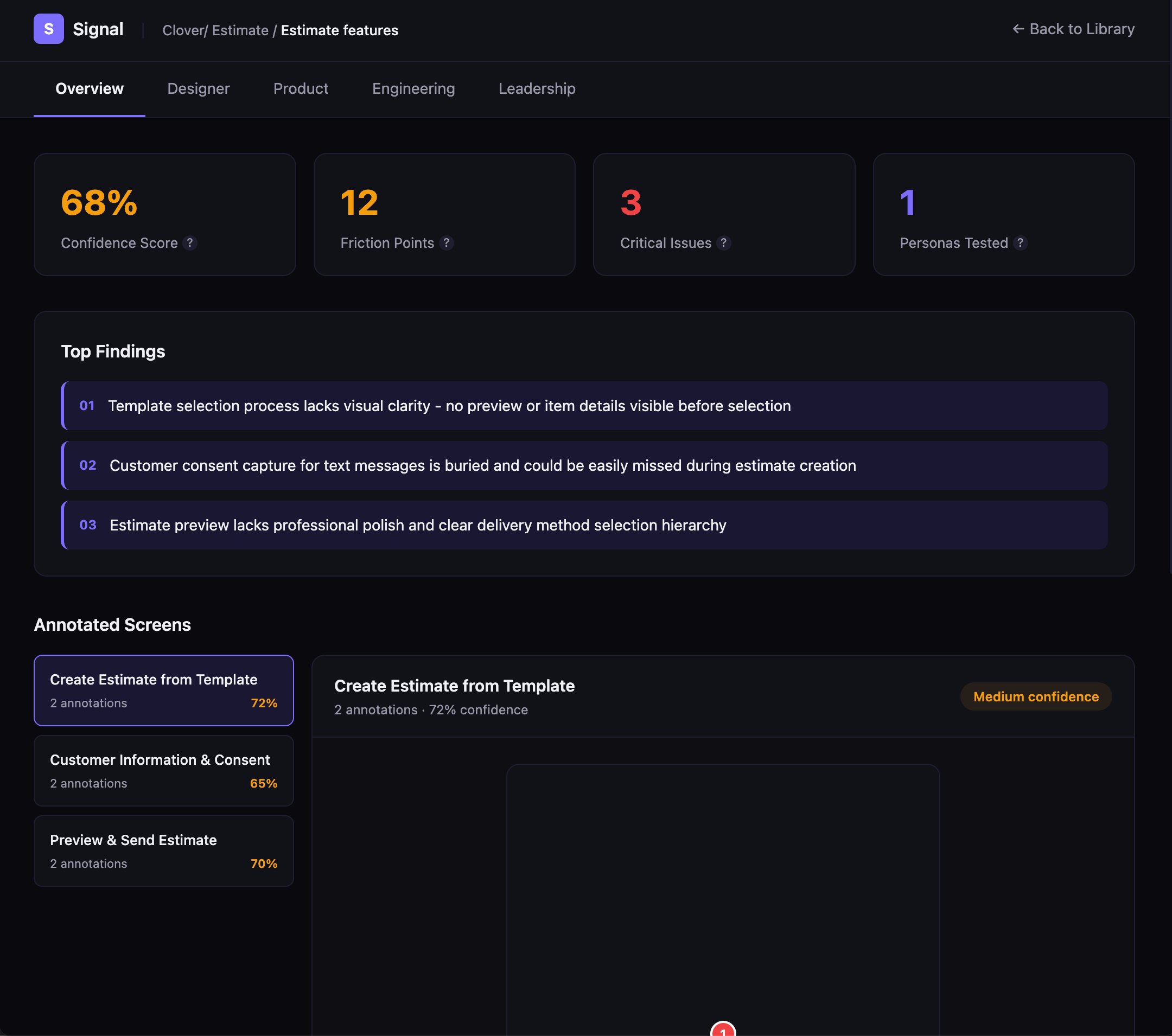
Frame-level findings mapped back to specific screens. Interaction issues, flow gaps, and persona friction points with enough specificity to act on immediately.

Output 02 + 03

Product & Engineering

Two separate outputs, each framed for its audience. Product gets requirements gaps and user impact. Engineering gets edge cases and technical concerns.

Output 04

Leadership

Risk summary, confidence level, and strategic flags. The signal that belongs in a steering meeting, not a design review.

How it works

From PRD to report.

Claude API Claude Vision Figma Plugin API React Node.js Vercel HTML / CSS / JS

01

Upload your PRD

Signal parses the requirements document to understand the intended experience, user goals, and success criteria before generating any personas.

Web App + Plugin

02

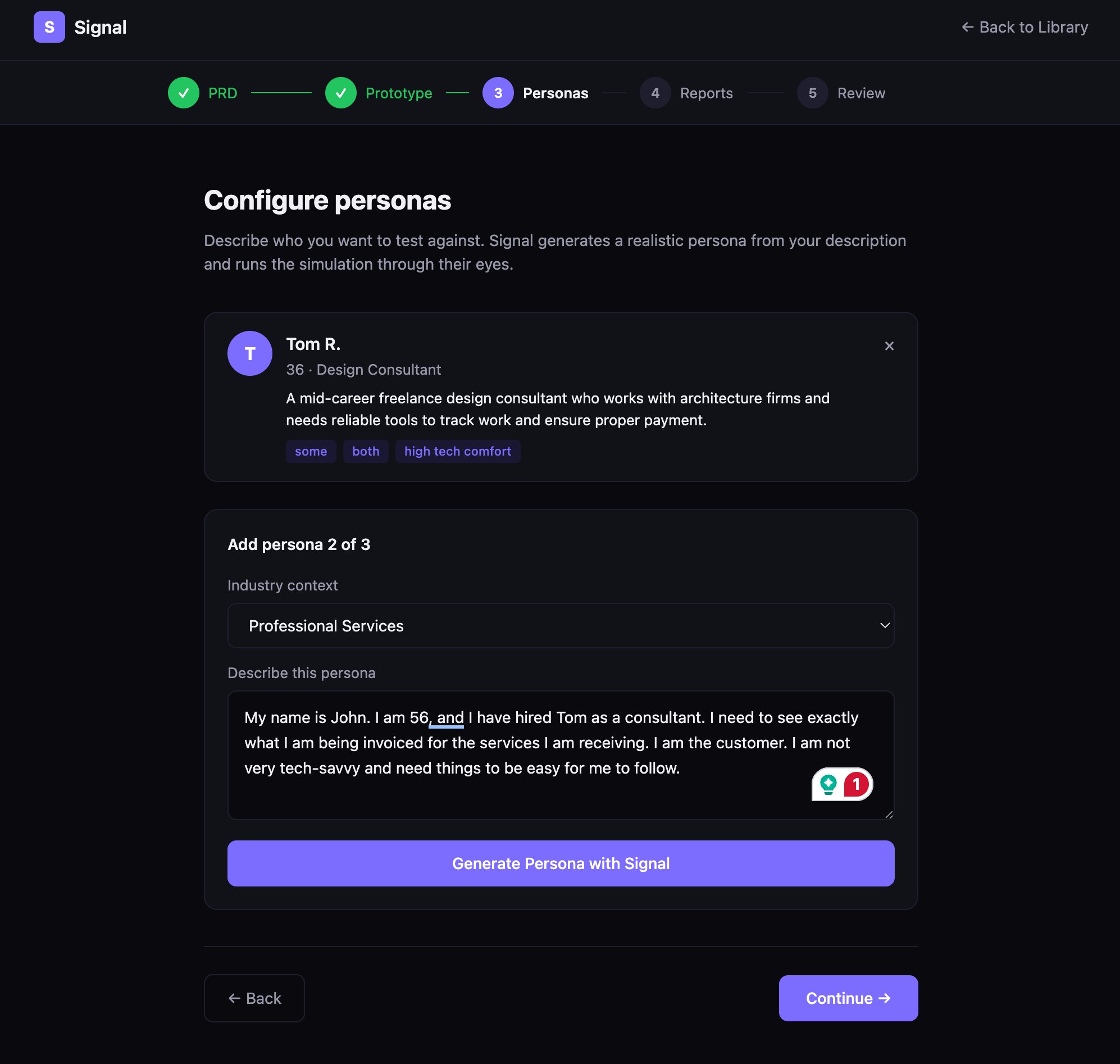
Build your personas

You define the persona details and map each one to an industry. Signal generates a structured persona card from your input, which Claude uses as the lens for the simulation.

Claude API

03

Run the simulation

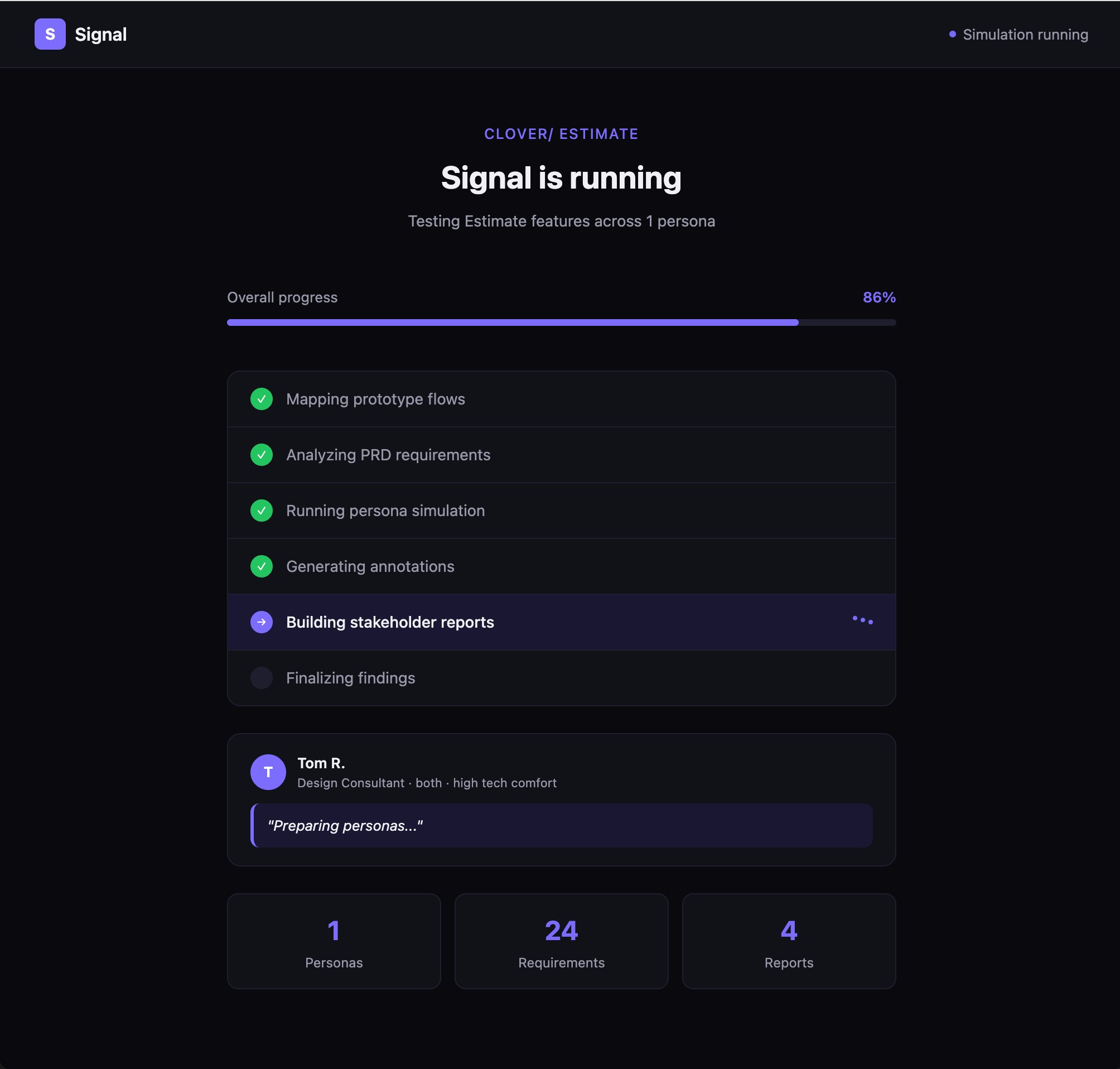
Claude receives the actual Figma frames as images via the plugin, sees what's on screen, and maps findings back to specific frames in the flow.

Claude Vision

04

Get the report

Four simultaneous outputs: Designer, Product, Engineering, Leadership. Each formatted for how that audience acts on information, not a single report everyone decodes on their own.

4-Tab Output
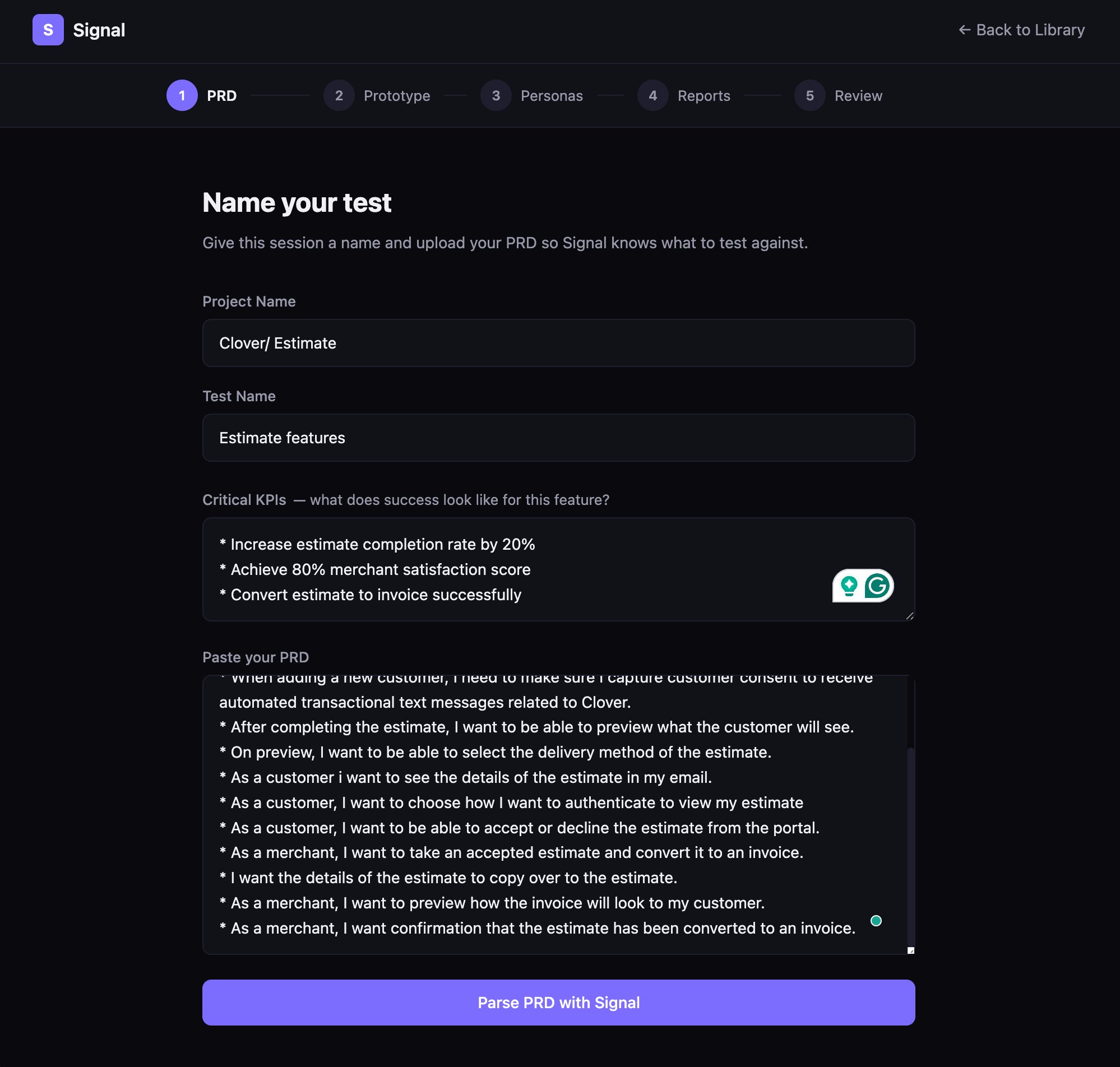
PRD Upload
Persona Generation
Simulation Running
4-Tab Report Output

AI Collaboration

Claude wasn't a tool.
It was a collaborator.

I treated Claude as a senior technical partner throughout the build: not for code generation, but for architecture decisions, edge case pressure-testing, and the kind of questions that usually require a room full of people. These are three conversations that shaped what Signal became.

01 / Architecture

"How should I model personality as a structured input so the simulation produces meaningfully different outputs per persona, not just paraphrased versions of the same feedback?"

What it unlocked

A three-axis persona framework: goal orientation, tolerance for ambiguity, prior mental model. Each axis produces genuinely divergent simulation output. Each persona reads as a person, not a stereotype.

02 / Edge Cases

"What edge cases should I stress-test in the four-tab report before assuming the structure is solid — specifically the Engineering and Leadership tabs?"

What it unlocked

14 edge cases I hadn't considered: conflicting signals across persona types, PRD gaps that only manifest in simulation, and findings that are technically correct but strategically irrelevant to leadership. Each became a test case.

03 / The Pivot

"The web app requires exporting screens manually from Figma. That friction is killing the use case. What are my options for getting real frame data directly into Claude without that step?"

What it unlocked

The Figma plugin architecture. Claude outlined the plugin API's image export capabilities, sandbox constraints, and how to pass frame data to Claude Vision. The pivot from web app to plugin traces directly to this conversation.

Chelsea Vision, craft, judgment
  • Problem definition and product vision
  • UX architecture and report structure
  • User research to validate each output tab
  • Design decisions and interaction patterns
  • Quality bar and direction for each iteration
+
Claude Architecture, analysis, scale
  • Persona axis framework and simulation logic
  • Edge cases and stress-testing
  • Plugin architecture and API patterns
  • Visual analysis of frames via Claude Vision
  • Code scaffolding and implementation

Where it stands

One version live. One in progress.

Live

Web App

Fully deployed. PRD upload, persona generation, screen upload, four-tab report output. The core loop is complete and running real API calls.

View live app

In Progress

Figma Plugin

Functional locally. Frame selection, PRD parsing, and Claude Vision analysis all working. Visual design pass and persona reuse in progress before public release.

In Progress

Persona reuse Save and recall personas across sessions for returning projects
Iteration delta Compare Version A to Version B with before and after annotations

Planned

PRD gap analysis Predict edge cases the team didn't write down
PRD coverage tracker Map requirements to validated design decisions across the full project

Reflections

What I learned.

01

Building your own tools changes how you think.

Testing Signal against real Clover work surfaced issues I hadn't caught in my own designs. The tool became its own proof of concept before it was finished. Using the thing you're building to improve the work you're doing is something I had read about but not experienced until Signal.

02

The honest pivot is always the right one.

It would have been easier to ship the web app and call it done. The concept worked, the demo was strong, and the story was clean. But I kept asking why we couldn't use the real screenshots. The answer wasn't good enough. The pivot to the Figma plugin added months and required learning a new build environment. It was the right call.

03

AI collaboration is a skill, not a shortcut.

The quality of what Claude contributed was directly proportional to how well I framed the problem. Vague prompts produced vague answers. Specific, constrained, well-structured questions produced architecture decisions and edge cases I genuinely hadn't considered. Learning to collaborate with AI well is its own design discipline.

Next Case Study

Clover Estimates